Workflow
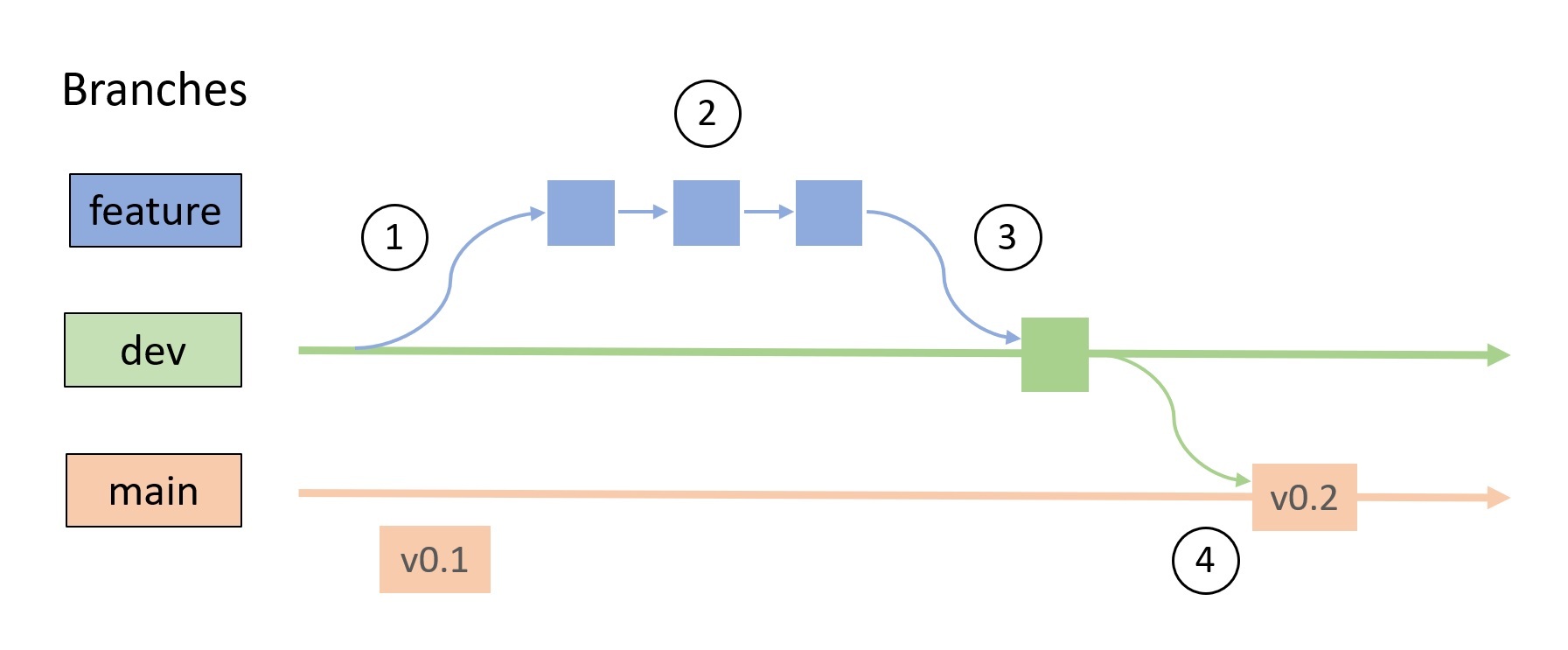
Use git flow: main branch is for releases, development for development, both should be stable (all tests must pass), but development branch gives an extra for fixing bugs.
- Read CaImAn CONTRIBUTING
- Create
developmentbranch. - Protect
mainanddevelopmentbranches so they can't be pushed to, see docs
General workflow:
- pick an issue or feature to develop and create a new branch off of
development. - when ready, open a pull request (to
development) and address any issues that come up, including ensuring that tests pass - merge into
development. - after enough time or enough changes, merge into
mainand make a release.
Versioning
Releases should follow semantic versioning and deploy to pypi (and optionally conda), see the notes on packaging and continuous integration for more. Semantic versioning means version try to use the following scheme:
Given a version number MAJOR.MINOR.PATCH, increment the:
  -  MAJOR version when you make incompatible API changes
  -  MINOR version when you add functionality in a backward compatible manner
  -  PATCH version when you make backward compatible bug fixes
In practice, it is hard to determine what a "breaking change" is. For example, is it considered a breaking change if you change a private method in a backwards-incompatible way? In python, users are not supposed to rely on methods that begin with an underscore, but if your package is large enough, someone almost certainly does (relevant xkcd). Some developers have tried to address these concerns by focusing their versioning protocol on authorial intent, trying to avoid sounding like they're making guarantees about breaking changes (see the INTERSECT packaging training for this protocol and more thoughts on this).
Regardless on what you decide, you should explain your scheme in your CONTRIBUTING.md file (see this repo's included file for an example).
Decision-making / gate-keeping
- Every repo should have a CODEOWNER who must approve any PR before merge into
developmentandmain. - Code owner can decide whether they want secondary approval from someone, which can be enforced by Github through branch protection rules.
